
About
Peter Mueller is a landscape painter based near Troy, New York. His work focuses primarily on the forests, farmland, back roads, creeks, and quiet corners of the Rensselaer Plateau and surrounding regions of eastern New York.
Working in acrylic, gouache, pen and ink, and relief printmaking, he often begins paintings outdoors through direct observation before completing them later in the studio. His paintings are inspired by a deep appreciation for the character of natural places and the quiet beauty of the landscapes people live alongside every day.
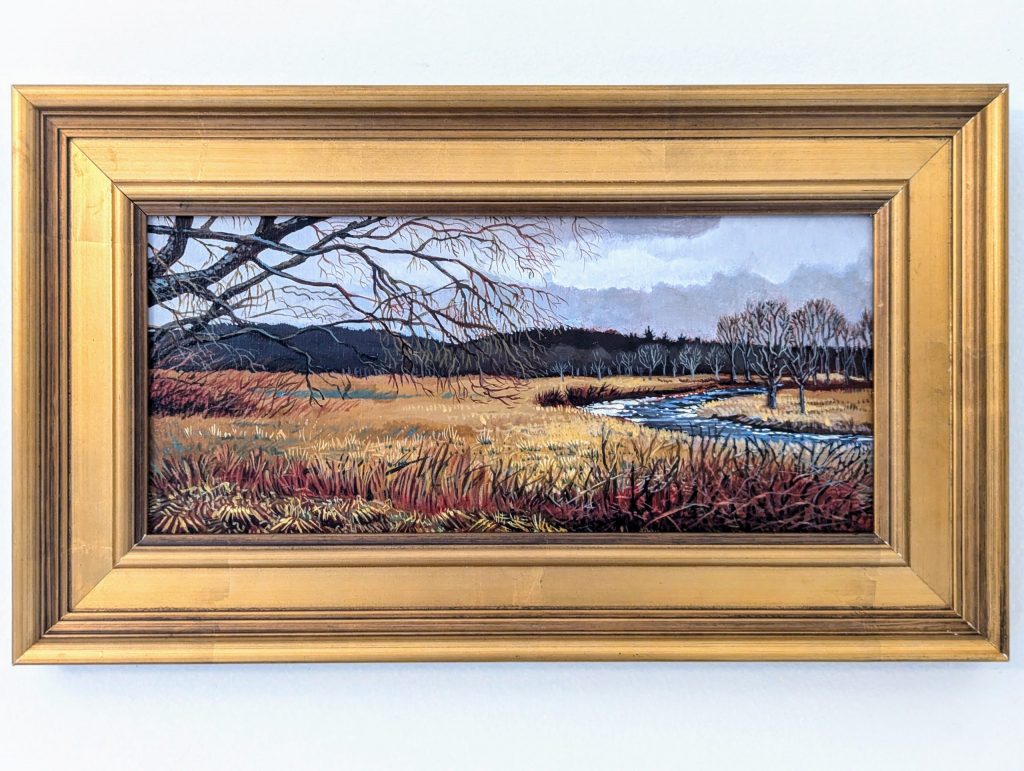
Many of his works explore locations that are easy to overlook: roadside trees in evening light, narrow creeks at the edge of farm fields, overgrown trails, wet spring woods, and rural hillsides in changing weather. Through painting, he aims to preserve and amplify these moments of atmosphere, season, and place.
In addition to independent work, Peter also creates commissioned paintings of meaningful landscapes, homes, farms, and properties throughout New York’s Capital Region, Hudson Valley, Adirondacks, and beyond.
This site serves as an ongoing collection of paintings, sketches, prints, and writing connected to the landscape of the northeastern United States.
Artist Philosophy
Peter believes paintings are meant to be functional parts of the home. Although they appear static and practical in no obvious way, they serve an important purpose: reminding us of the beauty that surrounds, but so often goes unnoticed.
In contrast to the digital screens that dominate modern life, a painting offers the same quiet image each time it is encountered. Over time, that consistency invites deeper attention. A person may pass by it casually one day and linger with it more thoughtfully another. The image remains steady while the viewer changes.
What many people do not realize is how much time an artist spends looking at a scene while creating a painting. Hours of observation allow layers of visual structure, atmosphere, memory, and emotional significance to become embedded in the final work. The goal is not simply to reproduce the photographic appearance of a place, but to convey the feeling of being there: the stillness of evening air, the smell of damp underbrush, the calm of standing beside a quiet creek or field.
To achieve this, a painting must balance emotional intensity with a believable sense of place. It should heighten and amplify the experience of the landscape without losing the grounded feeling that the viewer could step directly into the scene itself.